Want To Improve NPS? Start With Employee Engagement
Boost NPS by investing in employee engagement. Discover why better frontline support drives better customer outcomes.


If you’re an operations leader, you already know that net promoter score (NPS) is a litmus test for whether your frontline teams are equipped, supported, and empowered to consistently deliver on your brand promise.
When NPS drops, it's tempting to look at new tech, revamped scripts, or more customer surveys. But what if the real solution isn’t downstream? Data proves that NPS is impacted by how engaged your team members are.
The Research Is Clear: Employee Engagement Impacts NPS
A study published in the Journal of the Academy of Marketing Science found a direct link between employee engagement and customer satisfaction and retention. The more engaged your people are, the more likely customers will have positive, loyalty-building experiences.
After analyzing nearly 92,000 customer interactions in the car rental industry, researchers found a statistically significant relationship between employee engagement and both NPS and customer retention.
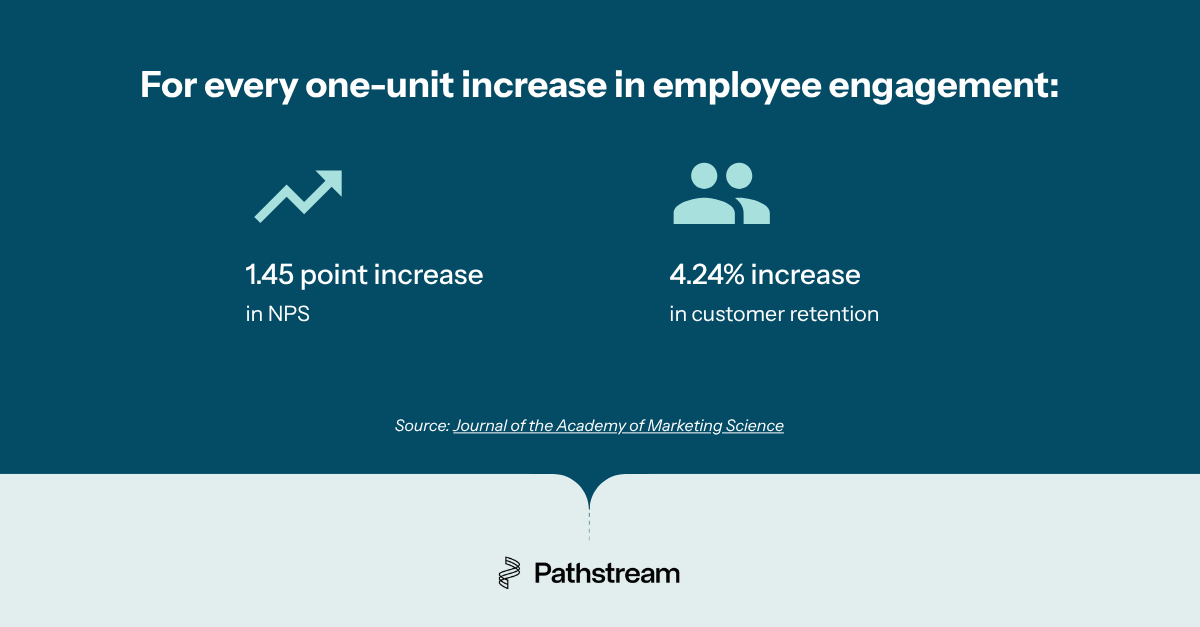
For every one-unit increase in employee engagement:
- NPS rose by 1.45 points
- Customer retention increased by 4.24 percentage points
This means even moderate gains in engagement, through better coaching, clearer development paths, or more consistent feedback, can directly lift core business KPIs.
This isn’t surprising. Engaged employees are more consistent, proactive, and focused on solving problems. That matters in high-volume service environments where customer experience hinges on every interaction.
How Employee Engagement Shows Up On The Floor
Imagine two identical teams with the same tools, processes, and staffing levels:
- Team A operates at high engagement. Supervisors coach weekly. Reps have clear development paths. Leaders regularly recognize wins and encourage growth.
- Team B struggles with low engagement. Supervisors are overloaded. Coaching is reactive or nonexistent. Reps spend the day in fire-drill mode with little feedback or visibility into advancement.
Which team delivers a better customer experience? Team A.
They’re more confident, consistent, and likely to go the extra mile.
Which team earns a higher NPS? Team A.
Customers notice when service feels thoughtful and human, and they reward you with loyalty.
Let’s quantify the difference.
Let’s say Team A scores 2 units higher on an internal engagement index than Team B, a realistic delta across teams with very different frontline cultures.
Based on research:
- Team A’s NPS would be ~3 points higher (2 units × 1.45).
- Team A’s customer retention could be ~8.5 percentage points higher (2 × 4.24).
Those numbers are meaningful at scale. Over tens of thousands of customer interactions, a few points in NPS and retention reflect millions in customer lifetime value and a tangible signal of operational health.
The Operational Bottlenecks That Drag Down NPS
Of course knowing there is a link between employee engagement and NPS doesn’t fix the problem.
If you're seeing flat or declining NPS, it's often due to your operational structure. Even your strongest teams will struggle to sustain performance when the environment works against them.
Here’s what that looks like on the ground:
- Supervisors are stretched, supporting 15 to 20+ reps, with little time for meaningful coaching.
- Reps can’t see a future. They’re focused on surviving the shift, not growing into the next role.
- Development is falling short. It’s entirely focused on check-the-box training. The skills needed to handle the next tough call are not being built.
These challenges are engagement inhibitors and performance barriers. They’re degrading service quality and causing frustrated customers and lower brand trust.
Your NPS catches these challenges first. When frontline teams don’t feel supported, customers don’t either.
That’s why closing the engagement-performance gap requires more than recognition programs or new KPIs. It requires readiness.
Your Frontline Team Wants Career Growth
Frontline associates consistently say they want career growth and to feel ready for AI and other workplace changes. Frontline leaders say the same, for themselves and for their teams. Yet, every minute of the workday is already committed to vital frontline work. Adding more time for training hours is simply unrealistic for most frontline teams.
That's Where Pathstream Comes In
Pathstream builds programs around frontline teams' work and life demands. Associates voluntarily enroll and stick with the program because it fits their lives, and the college credit is worth it to them.
Learn how you can improve employee engagement and NPS with Pathstream. Get started here.