AI Change On The Financial Services Frontline: What Leaders Must Get Right
We’ve been here before, and it changed everything. From JPMorgan to Wells Fargo and Bank of America, AI is impacting the frontlines.


Artificial intelligence, regulatory change, and rising customer expectations are reshaping financial services contact centers. The operational stakes are high. And yet, handled well, this shift will deliver gains: lower service costs, higher satisfaction scores, and frontline teams equipped to manage complex cases at scale.
We’ve been here before. And it changed everything.
The introduction of the internet.
The rise of smartphones.
These innovations redefined how we communicate, work, and deliver customer value.
AI is just as significant. The companies that moved early in those past shifts gained market share, retained talent, and set new service standards.
The same is true now.
AI Is No Longer Experimental
Jamie Dimon, CEO of JPMorgan, compared the coming wave of AI to the printing press and the steam engine. "We are completely convinced the consequences will be extraordinary,” he said in April 2024.
Wells Fargo CFO Mike Santomassimo went further in February 2025, telling UBS conference attendees that AI will touch nearly “every part” of the business.
This is not abstract commentary. When C-suite leaders speak this way, it signals both urgency and a need for operational execution.
David Khuat-Duy, now Chief AI Officer at Ivalua, stepped down from the CEO role to focus full-time on AI implementation. “The disruption… is so huge that there is nothing more strategic for the company, or even for humanity, than what is happening with AI.”
Bank of America CTO Aditya Bhasin put it in business terms: “Our use of AI… enables us to further enhance our capabilities, improve employee productivity and client service, and drive business growth.”
The business case is straightforward. AI adoption is an operational initiative. And that means frontline leaders need context, training, and tools — not just new systems.
Change Will Not Be Linear
Karen Webster, CEO of PYMNTS, outlined a familiar pattern: early hype, a trough of disappointment, then real impact at scale. PYMNTS Intelligence reports that high-impact GenAI use cases are already improving risk management, identifying 73% of fraud and error events in a recent study.
Operational leaders should expect a mix of fast wins (chat tools, workflow automation) and slower-moving cultural or training shifts. The ability to manage both is now a competitive advantage.
Frontline Leaders Are The Weak Link
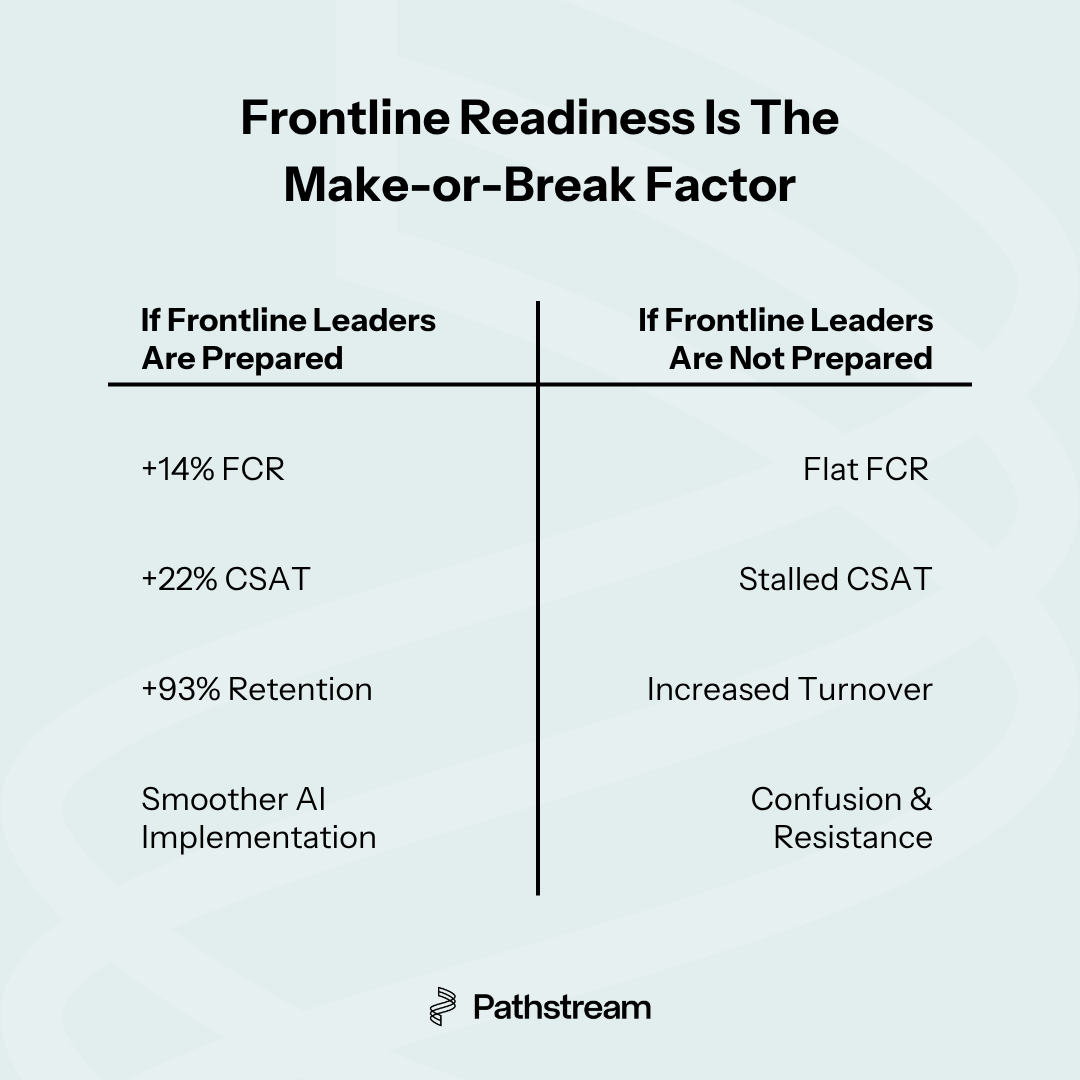
Change cascades through frontline leaders, but many lack formal communication, coaching, and change management training. The result: resistance, churn, flat FCR, and lagging CSAT.
A Practical Path Forward
Pathstream partners with Fortune 100 financial services contact centers to up-level frontline leaders through university-backed programs. Delivered off-the-clock and funded via tuition reimbursement, these programs are built to move business metrics:
- +14% first contact resolution
- +22% CSAT scores
- +93% frontline associate retention
Programs are designed in partnership with top universities. They focus on KPIs that matter to financial services contact centers and are consistently rated highly by frontline teams.
Frontline Leaders Control The Outcome
If they can lead through change, you’ll see it in the numbers — higher CSAT, better FCR, lower attrition. If they can’t, you’ll pay for it.
Learn more about university certificate programs for customer contact teams tailored for your company. Enhanced CX for your customers. Cost savings for your company. College credentials for your team.