Empathy Builds Stronger Customer Relationships
Digital/mobile adoption is accelerating, but enduring customer success still depends on bankers and their ability to be empathetic.


Earlier this month at MoneyLive North America, one theme surfaced repeatedly: digital/mobile adoption is accelerating, but enduring customer success still depends on bankers and their ability to be empathetic.
Empathy As Strategy
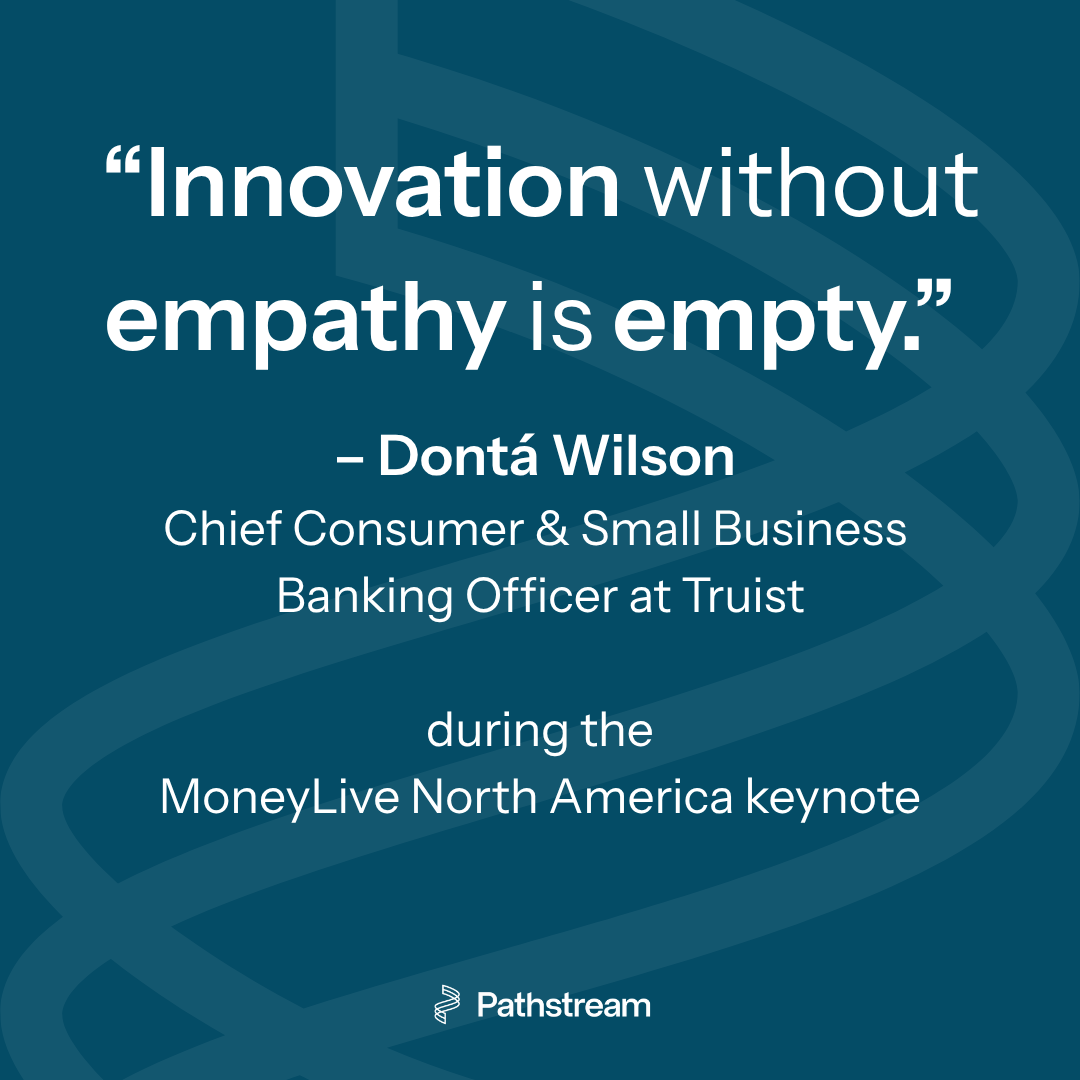
Dontá Wilson, Chief Consumer & Small Business Banking Officer at Truist, opened the conference with a clear warning: “Innovation without empathy is empty.” Technology may streamline banking, he noted, but performance still rests on employees connecting with customers.
What Is Empathy?
Wilson referenced Stanford psychologist Jamil Zaki, who defines empathy as “our emotional and psychological entanglements with each other.”
Can People Become More Empathetic?
Yes.
In his video “Build Empathy in a Fractured World,” Zaki articulates, “Empathy can be viewed as a skill.” He explains that empathy can be built on purpose and atrophies if not used. “Simply understanding that we can build empathy is the first step towards doing it,” he says.
Why Is Empathy Important For Bankers?
There’s an empathy-powered shift happening in banking right now. Instead of focusing on transactions and utility, banks are prioritizing the customer experience and offering tailored advice.
Empathy helps employees understand the why for the customer, driving stronger relationships and better service delivery. “When you have empathy, you build better relationships,” Wilson said.
Revenue follows. Wilson emphasized that banks win when clients win, not vice versa. Purpose and performance coexist when employees lead with care.
Other Banking Leaders On The Importance Of Empathy
- Fifth Third Bank: Jamie Heidrich, VP Senior Digital Product & Channel Manager, declared, “Customers don’t wake up excited to bank!” during a panel session on empowering customers via digital self-service banking. “So our job is to make the banking experience as frictionless as possible.”
- TD: During her keynote, Jo Jagadish, EVP Head of Digital Banking & Contact Centers, remarked, “Employee readiness [at the branches and on the phones] is critical.” She shared that 30% of digital logins lead to a contact center call, which is why her role includes both digital banking and contact centers. TD is building a frictionless customer experience through omnichannel, end-to-end customer journeys.
- Synovus: Katie Webb, Chief Digital & Experience Officer, talked about the banking transition from transactional to transformational and said the focus must be on “humanizing the digital experience” to make it “intentionally human.”
- Barclays: Sean Murray, Chief Product Officer, said people must “focus 100% on customer-first.”
Prioritizing The Customer In Banking
Wilson described today’s banking target as creating something “transformative for individuals.” In his view, customer success equals bank success, and empathy must be codified to achieve it.
In our current tech-driven environment, it’s easy for digital, mobile, and AI innovations to soak up all the oxygen in pursuit of short-term outcomes. However, long-term gains are built on enduring customer relationships. And that requires empathy.
Help Your Frontline Team Get Ready For The Moments You Don't Automate
Associates and leaders want to grow in their careers and feel AI-ready, and leadership needs their frontlines ready to shift into higher-value work. Yet, frontline teams have little time during the workday to build and practice the skills they will need next.
With Pathstream, associates build the durable skills and judgment needed to succeed in work increasingly shaped by AI. Associates opt in to invest in themselves, earning college credit and getting 1:1 coaching. Completing coursework when convenient for them, associates develop the skills needed to shift from transactional tasks into relational and strategic work.
Unlock development time for your frontline associates and leaders with Pathstream. Get started here.