Get in touch

AI At The Tipping Point: What Frontline Leaders Must Know Now

Focused frontline agents using headsets and computers, highlighting the rising impact of AI in the frontline

As AI reshapes the workplace faster than most executives anticipated, senior operations leaders face a stark choice: lead the transformation or get left behind.

Across industries, the urgency surrounding AI is palpable, fueled by:

  • Escalating expectations from the C-suite
  • Mounting risks to frontline employment
  • A growing disconnect between technological investments and workforce preparedness

For large, distributed organizations, the challenge isn’t just AI adoption. Success for frontline AI initiatives means execution at scale, across diverse teams and markets.

However, AI's rapid advancement has left many leaders feeling unprepared. Recent data and executive insights shed light on the mounting pressures, implementation hurdles, and actionable steps frontline operations leaders can take to ready their teams.

Let’s take a look:

1. AI As A Leadership Imperative

A survey by Harris Poll for Dataiku found:

79% of U.S. CEOs fear job loss within two years if they don’t deliver measurable AI outcomes.

“In a worst-case scenario, business leaders with a flawed AI strategy actually break something.” — Florian Douetteau, CEO, Dataiku

Implications For Frontline Leaders:

AI is both a business survival strategy and a performance lever, with the pressure cascading downward:

  • Expect your org to continue accelerating AI initiatives that must land across hundreds of teams or markets.
  • Workforce strategy needs to catch up to executive ambition quickly. This is your frontline execution differentiator.
  • If your frontline and field leaders aren’t aligned with AI readiness, your team could become the bottleneck to scaling.

2. AI Investment Is Up, But ROI Disappoints

While 61% of CEOs say they’re actively adopting AI agents and preparing to scale them, according to an IBM survey, only 25% of AI initiatives have delivered the expected ROI.

The top reasons AI has yet to live up to expectations are disconnected strategies, siloed teams, and low frontline readiness.

“The ultimate pay-off will only come to CEOs with the courage to embrace risk as opportunity.” — Gary Cohn, Vice Chairman, IBM

Implications For Frontline Leaders:

AI implementations are really about translating executive ambition into operational reality. That means:

  • Getting ahead of adoption pitfalls by ensuring the frontline understands the what, where, why, how, and when of your AI plans.
  • Preparing middle managers and field leaders before your next wave of AI deployments. They are your operational linchpins.
  • Challenging siloed rollouts by advocating for end-to-end integration between tech, training, and process redesign.
  • Taking accountability for early outcomes. Your team’s CSAT, handle time, and retention will be where the ROI (or lack of it) shows up first.

3. The Workforce Is Already Feeling The Impact Of AI

According to SHRM: 12.6% of U.S. jobs (19.2 million) are at high risk of AI displacement. Roles in service, support, manufacturing, and transportation are most exposed.

“HR leaders must focus on workforce agility by investing in continuous learning, reskilling, and redesigning roles to complement automation.” — Justin Ladner, Senior Labor Economist, SHRM

Implications For Frontline Leaders:

AI disruption has started, even if it hasn’t hit your team yet. Here’s how you can take action:

  • Focus on evolution, not fear. Prepare frontline teams to shift from task execution to problem-solving.
  • Start mapping which frontline workflows are being reshaped and what capabilities will be needed instead.
  • Coach frontline supervisors and managers on how to lead amid change and uncertainty. They’re the face of transformation.

4. Too Many Orgs Are Skipping The People Part Of AI Strategy

Despite pouring money into tools and talent, many organizations are neglecting their frontline workforce when it comes to AI readiness. The result? A growing AI capability gap.

  • Only 31% of workers say their employer provides AI training
  • 41% of IT decision-makers cite limited budgets as a major training blocker.
  • 54% of CEOs are hiring for AI-related roles that didn’t exist a year ago — an expensive bet on external talent
“The key challenges are not just anticipating displacement and replacement, but actively shaping the future of work and focusing on transformation of roles.” — Justin Ladener, SHRM

Implications For Frontline Leaders:

The skill gap is an operational performance risk. To fix it, you need to:

  • Own reskilling as a core part of your frontline operations strategy.
  • Prioritize role-relevant upskilling tied to frontline KPIs like CSAT, resolution time, and quality assurance.
  • Equip managers first. They’re the critical link between executive ambition and daily behavior.

5. What High-Performing Orgs Are Doing Differently About AI In The Frontline

McKinsey found that organizations seeing real ROI from AI are:

  • Redesigning workflows, not just layering tools on top
  • Putting senior leaders in charge of AI governance
  • Tying AI to KPIs and tracking performance
  • Building momentum through training and change management
“Getting real value out of AI requires transformation, not just new technology.” — Alexander Sukharevsky, Senior Partner & Global Co-Leader of QuantumBlack, AI by McKinsey

Implications For Frontline Leaders:

AI success requires operational fluency. Here’s what you can do:

  • Challenge “tech-first” rollouts by asking, “How does this reshape work for the frontline?”
  • Ensure your frontline team understands the new metrics of success.
  • Support governance with coaching and trust-building, especially across mid-level leadership tiers.

What To Do Next: 5 Moves To Make AI In The Frontline Work

Here’s what you can do now to get aligned with your CEO’s AI ambitions:

  1. Assess Exposure: Where are AI pilots already touching frontline workflows? Where is training missing?
  2. Reskill Managers & Team Members: Everyone on the frontline needs support to understand, trust, and use AI in their roles. Upskilling must extend across roles to build collective confidence and capability.
  3. Redesign Workflows: AI layered onto old processes leads to confusion. Redesign instead of retrofitting.
  4. Clarify Accountability: Who owns each AI initiative? And what does frontline success look like?
  5. Coach For A Growth Mindset: Your team’s willingness to experiment, learn, and adapt will determine whether AI works. Invest in coaching that helps your managers and team members build resilience and curiosity.

At The Tipping Point: Lead AI Change With Clarity

AI change is here, and your team knows it. Frontline leaders must set a tone of honest urgency, backed by explicit action.

“If you think you’re going to try to game this, and that you’re going to tell employees nothing’s going to change, and everything’s going to be fine, that’s just BS.” — Jim Kavanaugh, CEO, World Wide Technology

If AI ROI Is A Mandate, Your Frontline Can’t Be An Afterthought

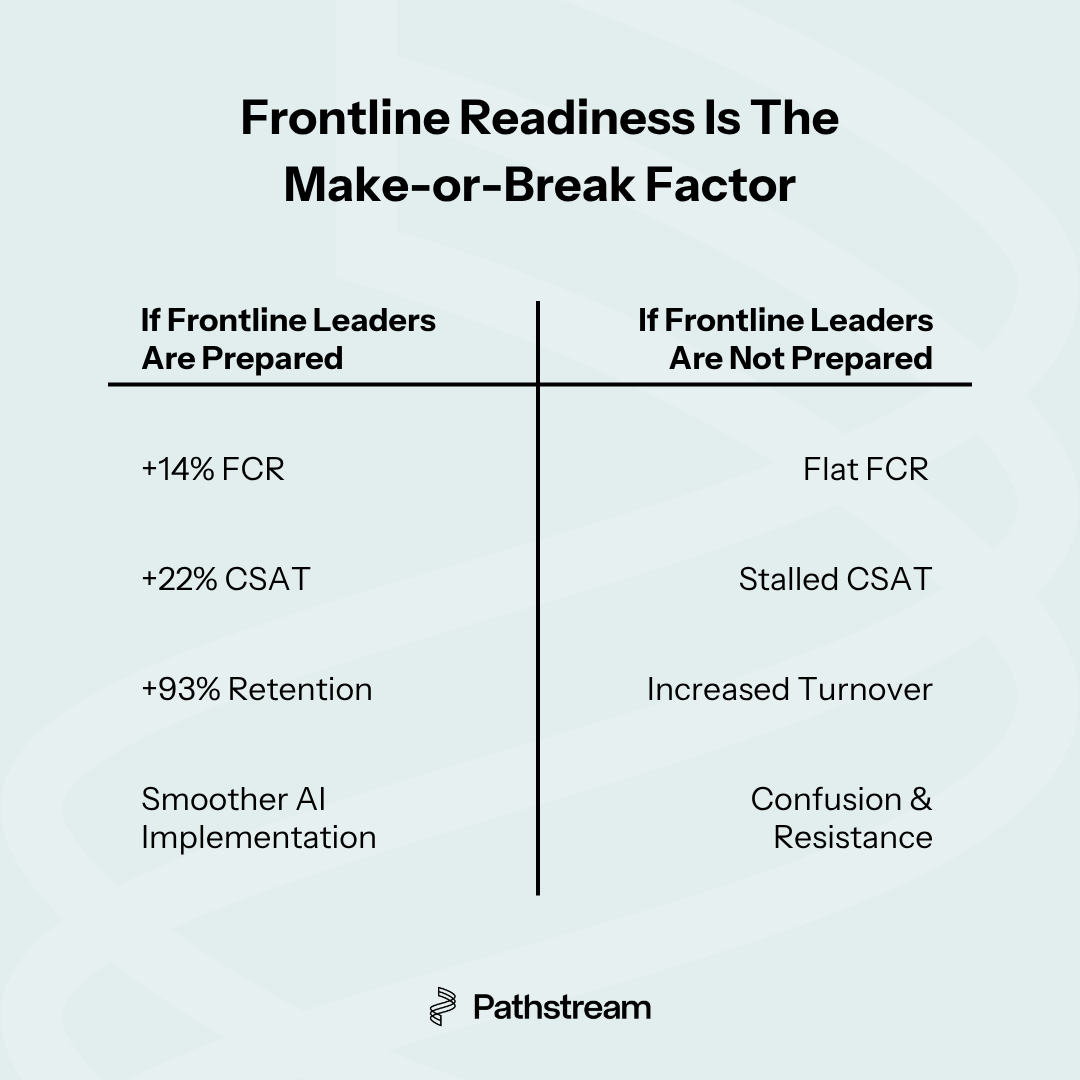
Leading operations teams are closing the AI readiness gap with Pathstream coaching and upskilling to build adoption, confidence, and capability where it counts most. Request a call with the Pathstream team to learn more.